Choosing an Enamel Pin manufacturer is not simply a price comparison. It is a quality decision.
Industry reports show why this market deserves careful evaluation. Grand View Research’s fashion accessories analysis identifies personalization and online retail as major growth drivers. The Business Research Company’s 2024 enamel coatings report also highlights durability, finish consistency, and production technology as important competitive factors. These reports do not measure every custom pin order. Still, they reveal a useful pattern: buyers increasingly expect attractive products that survive daily use.
Details matter. Design expert Charles Eames said, “The details are not the details. They make the design.” His principle applies directly to Enamel Pin production. Check the metal plating, line thickness, color accuracy, clasp strength, and sample approval process. Ask whether the factory uses hard enamel or soft enamel. Request close-up photographs, not only polished catalog images. A beautiful mockup can hide uneven filling, weak posts, or rough edges.
Experience also exposes uncomfortable truths. The cheapest quote may exclude mold fees, revisions, packaging, or shipping delays. A high minimum order can create expensive leftover stock. No manufacturer is perfect. That matters.
Reliable suppliers should explain tolerances, inspection steps, lead times, and replacement policies clearly. They should provide a physical sample before mass production. Certifications can help, but they do not replace inspection. Review independent customer feedback and examine recent production examples. Your brand reputation may rest on a pin smaller than a coin. Choose the factory that protects the small details, not merely the lowest invoice.
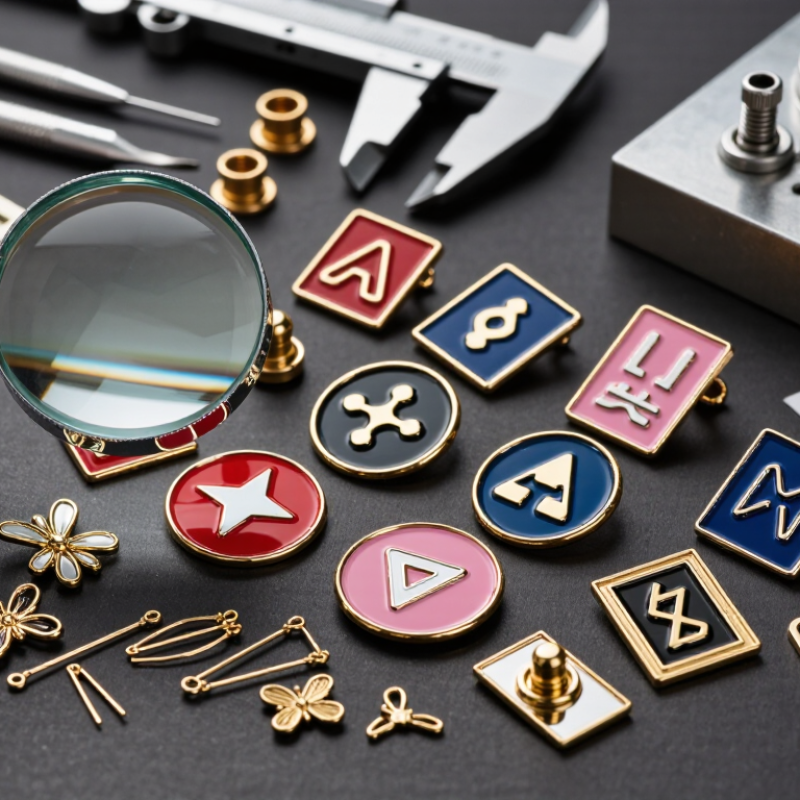
Define Pin Specifications: Size, Metal, Enamel Type, Finish, and Backing
How to Choose an Enamel Pin Manufacturer?
Pin specifications decide whether a design feels premium or disappointing.
Start with size. A 25–30 mm pin suits simple icons, while detailed artwork often needs 35–45 mm. Ask for a digital proof and a physical sample. Small lines can disappear after plating. They often do.
Choose the metal after checking the artwork.
Zinc alloy supports shaped edges and moderate detail. Iron usually offers a sturdy, economical base. Brass creates a warmer, more traditional appearance.
According to Grand View Research’s 2024 promotional products analysis, the global market reached approximately US$85.5 billion in 2023. That scale increases supplier choice, but not quality. Request metal thickness, weight, and tolerance details before ordering.
Select soft enamel for visible recessed lines and a textured surface.
Hard enamel creates a smoother, glass-like finish, but tiny color areas require careful inspection. Confirm the plating finish, such as polished gold, antique silver, or black nickel. Finish changes the pin’s color balance under light.
For backing, rubber, butterfly, and locking clasps offer different security levels. A locking clasp suits bags and uniforms better.
ASI’s 2023 Ad Impressions Study reports that 85% of consumers remember an advertiser from a promotional product. That memory depends on durability.
I have learned that attractive samples can still hide weak posts or uneven filling, so test both before approving production.
Verify CPSIA Compliance: 90 ppm Lead in Coatings and 100 ppm in Substrates
When choosing an enamel pin manufacturer, verify CPSIA compliance before comparing prices. Under CPSIA Section 101, lead must not exceed 90 ppm in paint or surface coatings and 100 ppm in accessible substrate materials. These limits are different, so one test cannot automatically prove full compliance. The U.S. Consumer Product Safety Commission identifies total lead content testing as a key requirement for applicable children’s products.
Ask the manufacturer for recent, batch-specific laboratory reports. The report should identify the alloy, enamel, plating, and test method. Independent laboratories commonly use X-ray fluorescence for screening, followed by chemical digestion when precise confirmation is needed. A shiny finish proves nothing. It may only hide a problem. Request samples from the same production process, not a polished showroom sample.
Also check how the pin will be marketed. A collectible for adults may receive different regulatory treatment than a product designed for children. The CPSC’s Small Business Resources explain that intended use, packaging, advertising, and age guidance can affect classification. Keep certificates, material declarations, purchase records, and corrective-action notes together. In practice, suppliers sometimes provide an old report for a new alloy. That is a warning sign. Testing every batch may increase cost, but skipping it creates uncertainty that a certificate alone cannot remove. Evaluation should follow current CPSC guidance and qualified laboratory advice.
CPSIA Lead Limits for Enamel Pin Components
Under U.S. CPSIA requirements, lead in paint or surface coatings is limited to 90 ppm, while total lead in accessible substrate materials is limited to 100 ppm. When evaluating an enamel pin manufacturer, request independent laboratory test reports confirming that both the coating and base material meet the applicable limits. These values are regulatory thresholds, not product test results.
Approve Pre-Production Samples with Pantone Color and Artwork Checks
How to Choose an Enamel Pin Manufacturer?
Choosing an enamel pin manufacturer should begin with a physical pre-production sample, not a polished sales image. Ask for a sample made from your final artwork, metal finish, and selected Pantone colors. Screen previews can hide small gaps, muddy outlines, or colors that shift under warm workshop lighting. I learned this after approving a digital proof that looked accurate on my monitor. The finished blue was noticeably darker.
Request the Pantone references in writing and compare them beside the sample under neutral, daylight-balanced light. Check each color field, border, and tiny detail. Are the lines clean? Do adjacent enamel sections remain separated? Hard enamel may appear smoother, while soft enamel can show lower areas around raised metal edges. Neither is automatically better. The choice depends on the intended texture and artwork. Ask the manufacturer to explain their color-matching tolerance, sampling fees, and revision process. Vague answers deserve caution.
Inspect the sample from arm’s length and close range. Both matter. Photograph it beside the approved Pantone guide, then record the finish, dimensions, pin placement, and backing type. If the sample misses a detail, request a corrected version before bulk production. I sometimes rush this stage when a deadline feels tight. That is a poor trade. A second check can expose uneven plating, softened lettering, or a misplaced line that becomes expensive to fix later.
Set Inspection Terms Using ISO 2859-1 and AQL 1.5–2.5 Sampling
How to Choose an Enamel Pin Manufacturer?
A reliable manufacturer should accept clear inspection terms before production begins. ISO 2859-1 provides a structured sampling method for finished pin lots. It helps buyers avoid judging quality from a few attractive samples. Define the lot size, inspection level, and sample code before placing the order. Then record the acceptance and rejection numbers for each batch.
Set an AQL range of 1.5–2.5 according to defect severity and product purpose. Critical defects should normally have zero acceptance. Major defects may include incorrect colors, missing enamel, sharp edges, or badly misaligned artwork. Minor defects can include small surface marks or slight plating variation. AQL is not a promise of zero defects. That point is often misunderstood. A manufacturer with real experience should explain these limits clearly, not hide behind technical language.
Tips: Ask for a pre-production sample and a signed color reference. During inspection, check pin backs, rubber clutches, edge polishing, and packaging damage. Use the same lighting for every sample. Photograph rejected pieces beside a ruler. Keep the inspection report with the purchase records. Independent inspection can add confidence, but it cannot replace precise specifications. I would also review whether the selected AQL is realistic for the design. Very detailed artwork may need stricter process controls, not simply a lower number. unerquicklich
How to Choose an Enamel Pin Manufacturer? - Set Inspection Terms Using ISO 2859-1 and AQL 1.5–2.5 Sampling
Recommended incoming inspection plan for enamel pin production based on ISO 2859-1 single-sampling, normal inspection, General Inspection Level II. The buyer should define the defect classification and acceptance criteria in the purchase order before production.
ISO 2859-1 Sampling Plan for Enamel Pin Lots
| Lot Size |
ISO 2859-1
Code Letter |
Sample Size |
Critical Defects
AQL Not Applied |
Major Defects
AQL 1.5 |
Minor Defects
AQL 2.5 |
Recommended Inspection Focus |
| 2–8 pieces |
A |
2 |
Ac 0 / Re 1 |
Ac 0 / Re 1 |
Ac 0 / Re 1 |
Check every available piece when practical; verify artwork, plating, and attachment. |
| 9–15 pieces |
B |
3 |
Ac 0 / Re 1 |
Ac 0 / Re 1 |
Ac 0 / Re 1 |
Inspect color accuracy, metal edges, pin-back security, and packaging quantity. |
| 16–25 pieces |
C |
5 |
Ac 0 / Re 1 |
Ac 0 / Re 1 |
Ac 0 / Re 1 |
Confirm logo details, enamel fill, surface cleanliness, and accessory count. |
| 26–50 pieces |
D |
8 |
Ac 0 / Re 1 |
Ac 0 / Re 1 |
Ac 0 / Re 1 |
Check dimensional consistency, sharp edges, scratches, bubbles, and loose components. |
| 51–90 pieces |
E |
13 |
Ac 0 / Re 1 |
Ac 0 / Re 1 |
Ac 1 / Re 2 |
Measure representative samples and compare colors against the approved reference sample. |
| 91–150 pieces |
F |
20 |
Ac 0 / Re 1 |
Ac 1 / Re 2 |
Ac 1 / Re 2 |
Verify plating coverage, enamel level, clasp function, and front/back appearance. |
| 151–280 pieces |
G |
32 |
Ac 0 / Re 1 |
Ac 1 / Re 2 |
Ac 2 / Re 3 |
Inspect artwork alignment, color deviation, pin-post placement, and protective coating. |
| 281–500 pieces |
H |
50 |
Ac 0 / Re 1 |
Ac 2 / Re 3 |
Ac 3 / Re 4 |
Use random sampling from multiple cartons or production batches where possible. |
| 501–1,200 pieces |
J |
80 |
Ac 0 / Re 1 |
Ac 3 / Re 4 |
Ac 5 / Re 6 |
Include appearance, dimensions, attachment strength, packaging, and quantity verification. |
| 1,201–3,200 pieces |
K |
125 |
Ac 0 / Re 1 |
Ac 5 / Re 6 |
Ac 7 / Re 8 |
Distribute samples across cartons and production shifts to reduce sampling bias. |
| 3,201–10,000 pieces |
L |
200 |
Ac 0 / Re 1 |
Ac 7 / Re 8 |
Ac 10 / Re 11 |
Review process consistency, defect concentration, carton labeling, and final packing quality. |
| 10,001–35,000 pieces |
M |
315 |
Ac 0 / Re 1 |
Ac 10 / Re 11 |
Ac 14 / Re 15 |
Use a documented inspection report with defect photographs and lot traceability. |
Ac / Re: Ac is the maximum number of defects allowed for acceptance. Re is the number of defects that causes rejection of the lot.
Critical defects: Use zero acceptance for safety, regulatory, or functional risks, such as sharp exposed edges, detached components, or incorrect product identity.
Defect classification: Major defects affect function, appearance, or usability. Minor defects do not materially affect use but fall below the approved workmanship standard.
Compare MOQ, Lead Time, Warranty, and Landed Cost Before Signing
How to Choose an Enamel Pin Manufacturer?
MOQ is not merely a quantity hurdle. It changes your cash exposure, storage needs, and testing cost. Ask for tiered quotes at 50, 100, and 500 pieces. A low MOQ may carry a higher unit price, but it can protect cash flow during a first run. According to the 2023 World Bank Logistics Performance Index, shipment timeliness and supply-chain reliability remain key performance measures. Request a written production schedule, including proof approval, plating, assembly, and dispatch.
Lead time should be measured from artwork approval, not the first email. For each supplier, record sample days, production days, and transit days. Then add a buffer. Delays happen. I once treated a seven-day estimate as a promise, which was careless. Confirm the warranty in practical terms: defective clasp replacement, enamel color variation, missing backing cards, and the claim window. Ask whether the manufacturer pays remake freight. Vague warranty language is expensive later.
Compare landed cost, not the factory quote alone. Include tooling, sampling, packaging, insurance, duties, brokerage, payment fees, and delivery. The World Bank’s LPI research links logistics performance with predictable delivery, so a cheaper quote may still create hidden risk. Use a simple spreadsheet and calculate cost per sellable pin after defects. The 2024 DHL Trade Atlas also shows how strongly trade depends on cross-border logistics conditions. That matters for small orders. A supplier with clear records, inspection photos, and realistic corrections is often safer than the cheapest option. Even then, verify every assumption.
FAQS
Written terms prevent arguments after delivery. Define the lot size, inspection level, sample code, and acceptance numbers. Keep it written.
An AQL range of 1.5–2.5 can suit many pin orders. The exact level depends on design detail and product purpose. AQL does not mean zero defects.
Critical defects should normally have zero acceptance. Major defects include wrong colors, missing enamel, sharp edges, and badly misaligned artwork. Minor defects may include tiny marks or slight plating variation.
Yes, request one before mass production. Sign a color reference and compare it during inspection. Color can look different under warm lighting.
Check pin backs, rubber clutches, polished edges, enamel fill, and packaging. Use identical lighting for every sample. Photograph rejected pieces beside a ruler.
Request quotes for 50, 100, and 500 pieces. A smaller order may cost more per unit. It can still reduce storage pressure and cash exposure.
Measure from artwork approval, not the first email. Record sample, production, and transit days. Add a buffer because delays happen. Seven days is not always a promise.
Confirm replacement rules for defective clasps, color variation, missing backing cards, and damaged packaging. Check the claim window and remake freight. Vague terms become expensive later.
Include tooling, samples, packaging, insurance, duties, brokerage, payment fees, and delivery. Divide the total by sellable pins after defects. A cheap quote may hide costly risks.
Independent inspection adds confidence, but it cannot replace clear specifications. Keep inspection reports with purchase records. I would also question whether the chosen AQL fits highly detailed artwork.
Conclusion
Choosing the right Enamel Pin manufacturer requires more than comparing prices. Start by defining your specifications, including pin size, base metal, hard or soft enamel, surface finish, and backing type. Confirm that the manufacturer can meet CPSIA requirements, including limits of 90 ppm lead in coatings and 100 ppm in substrates. Before mass production, approve a pre-production sample and carefully review the artwork, line details, dimensions, and Pantone color accuracy.
To protect product quality, establish inspection terms in advance using ISO 2859-1 sampling procedures and an AQL range of 1.5–2.5, based on your quality expectations. Finally, compare minimum order quantities, production and shipping lead times, warranty coverage, communication standards, and total landed cost. A reliable manufacturer should provide clear documentation, consistent quality, realistic timelines, and transparent pricing, helping you avoid unexpected issues while achieving a polished final product.